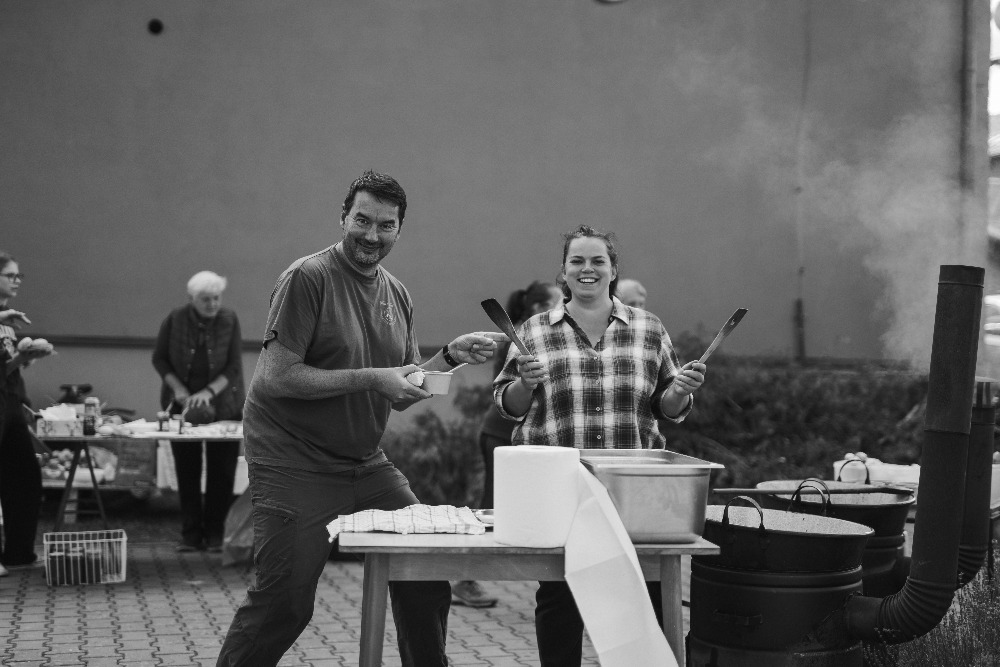
At Via Foundation, we believe in the power of active people. They are the ones who, in times of crisis, don’t hesitate: they get up from their chairs and go help. Just as they did in the fall of 2024, when heavy rains caused flooding in the Jeseníky and Rychlebské Mountains. The author of this article, Marie Krajplová, lives there. Within just a few hours, she saw with her own eyes how quickly an informal network of people from all over the Czech Republic can spring into action. People who had met at our seminars began calling and messaging each other to organize relief efforts. The strength of their ties rests on the trust they had built through Via programs, which our donors made possible. Thank you for helping to build relationships that endure – even when floodwaters rise.
We invite you to read her story.
When floodwater rise, relationships hold us together
In the fall of 2024, a flood struck the Jeseníky and Rychlebské Mountains, transforming the peaceful landscape into a scene of struggle against water, mud, and destruction within a matter of hours. I realized very strongly just how important the work is that I and others in the region have been doing for years—even if it sometimes seems like “just culture,” “just folklore,” or “just a community workshop.”
For many years, I’ve been organizing cultural and educational projects in our region, from putting on festivals (the Kolébka Literary Festival and the Blacksphere Festival) to managing the Uhelná Community Center and designing contemporary folk costumes for the Rychlebské Mountains. At its core, this work is about relationships. It’s about listening, trust, sharing, and collaboration. It’s about knowing the names of people in the surrounding villages, knowing who’s good at what, and what brings joy or causes sorrow.
And it was precisely this “invisible” bond—which had been building up among people for years—that suddenly began to function as a strong network in the moment of crisis. Within a few minutes of posting that we needed help, a dozen people reached out to me—some sent money, others offered advice and information, still others helped clean up the village, and others cooked meals or organized fundraisers. Without much planning, without complicated organization—simply because we know each other and trust one another.
In addition to providing practical help during a crisis, communities also have a huge impact on our mental health and long-term resilience. Numerous studies show that people who are part of an active community live longer, are less prone to depression, and cope better with life changes. In places where people talk to one another, visit each other, and create things together—such as folk patterns, music, or a community garden—something like “mental immunity” emerges.
I see this in practice among the women at the Uhelná Community Center, who come to help sew traditional costumes: the work brings them joy, a sense of purpose, and a feeling of belonging. And the same is true for people who come to a festival or get involved in preparing a cultural event. Suddenly they’re part of something bigger, they meet new people, and they learn that it’s possible to change the world with their own hands. All of this counts, even if it’s not easy to measure. We can call it community capital.
The fact that relationships and communities are the key to a good life is also confirmed by longitudinal research on human happiness. A Harvard study that has been tracking the lives of several hundred people for more than 80 years. The results are clear: the strongest predictor of long-term health, happiness, and satisfaction is not money, career, or background: it’s the quality of interpersonal relationships. People who are surrounded by close, trusting relationships live longer, get sick less often, and are better able to cope with difficulties.
We see this every day in our community work. The little things that come together to form a strong whole. From baking cookies to sewing to helping clean up after events. This “delicate web of human connections” is often the strongest thing we have. And it is precisely in times of crisis that it proves to be more resilient than any fence or flood barrier.
I’d like to highlight the incredible commitment of the people and organizations around me: from the Uhelná Community Center, Via Foundation, Neratov Association, and hundreds of donors, both large and small. Amid makeshift conditions and organizational chaos, yet with tremendous dedication and care, I witnessed something truly profound. It was the power of community in action.
This experience reaffirmed for me that the work of building relationships is not some “luxury in times of peace,” but rather a fundamental safeguard against any crisis. In times of prosperity, it may seem like a given—but when disaster strikes, it is the community that keeps people afloat. Literally.